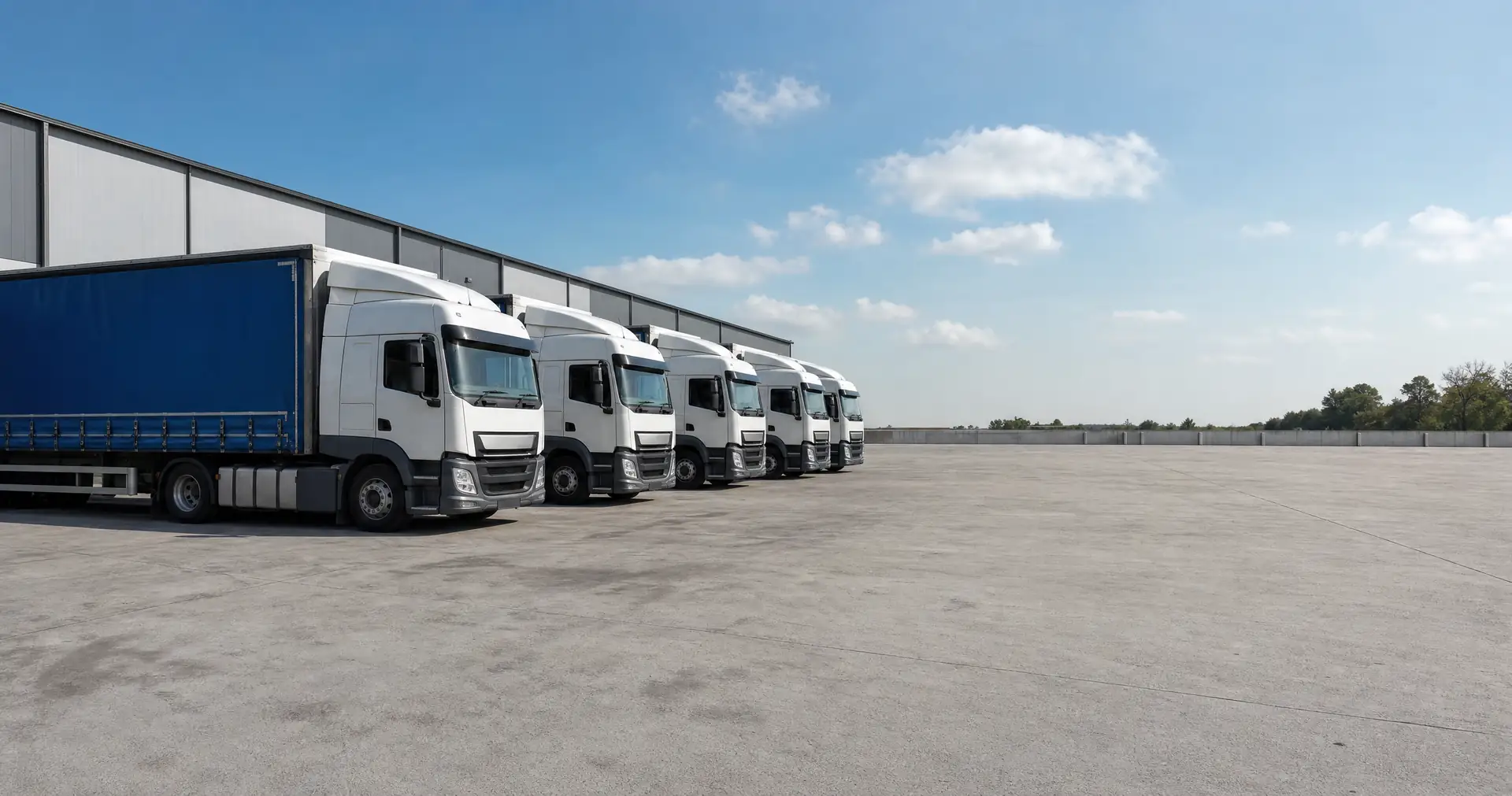
Equipment finance for New Zealand transport and logistics.
Transport operators replace equipment on a cycle rather than when it breaks, which makes this the sector where the end of a finance term matters as much as the start.
Indicative only. Not a quote or offer of credit. Actual rates, fees, and repayments depend on the business profile and the lender's decision.
Sending to Prospa
Your $175,000 scenario
5 years at 10.00% . Prospa will ask a few quick questions, then provide a firm quote and funding if eligible.
Redirecting…
The short version
Transport equipment finance in five lines.
→This is a rolling programme, not a purchase. Fleets replace units continuously, so the position at the end of each term feeds the deposit on the next. Managing that sequence matters more than any single rate.
→The equity position at trade-in decides the next facility. Where a trade clears the balance with a surplus, the surplus becomes the deposit. Where it does not, the shortfall raises the cost of the replacement rather than the machine being replaced.
→Road user charges dwarf the repayment. On a heavy vehicle running distance, road user charges are the largest single operating cost and no finance agreement covers them.
→Contracts and lanes make applications easier. A named freight lane with a term gives a lender a visible repayment source, which matters more than usual on the large amounts this sector borrows.
→Indicative only. Every figure on this page is illustrative. Actual rates, fees and terms come from the lender after assessment of the business and the specific vehicles.
The sector
Large fleets, planned replacement, thin margins.
New Zealand freight and logistics runs from owner-drivers subcontracting to larger carriers through to fleets of forty vehicles serving national distribution. What they share is that the equipment is the business, that it is replaced on a schedule rather than run to failure, and that the margins on freight are thin enough that operating costs decide profitability more than finance costs do.
The replacement cycle is what makes this sector different from every other on the site. A contractor might finance three machines in a decade. A transport operator with a twenty-unit fleet and a six-year cycle is settling and replacing three or four facilities every year, permanently. That turns equipment finance from a decision into a process, and the questions worth asking change accordingly.
The most useful of those questions is about the end of the term rather than the start. Depreciation on commercial vehicles is front-loaded, so a five-year facility on a vehicle traded at four commonly leaves a balance the trade does not clear. Rolling that shortfall into the next agreement is normal, is offered readily, and quietly raises the cost of the replacement. An operator running a rolling programme who tracks the equity position on each unit is making better decisions than one who looks only at the weekly figure on the next one.
Common fleet mix
Rigids, semis, forklifts
Indicative rate band
8% to 15% p.a.
Certification
Certificate of fitness
Registered on
PPSR
What gets financed
The equipment a New Zealand fleet typically carries.
Each of these has its own page covering indicative price bands, terms and the assessment specific to it. This page covers what changes because the borrower runs a fleet.
A fleet on a six-year replacement cycle is settling and replacing several facilities every year, which turns equipment finance from a decision into a process.
The rolling position
Every trade-in sets up the next deposit.
Commercial vehicle depreciation is front-loaded, so the balance owing falls more slowly than the value does through the first half of a term. A vehicle traded at four years on a five-year facility therefore frequently carries a balance the trade value does not clear, and the shortfall is commonly rolled into the replacement agreement. That is a normal, readily offered arrangement, and it quietly raises the cost of the new vehicle rather than the old one. Repeated across a fleet on a rolling cycle, the accumulated effect is material. Tracking the equity position on each unit, rather than only the weekly figure on the next purchase, is what keeps a replacement programme from getting progressively more expensive.
The cost stack
What a working heavy vehicle actually costs each week.
Illustrative structure rather than figures for any specific operation, because distance, weight, lane and vehicle all move every line. The point is the shape rather than the numbers, and the shape is that finance is the smaller half.
Cost
In the finance agreement
Scales with
Notes
Finance repayment
Yes
Nothing, it is fixed
The only line on this table a finance quote shows.
Road user charges
No
Distance and weight
Commonly the largest single operating cost on a distance-running vehicle.
Fuel
No
Distance and load
Moves with market pricing, independent of everything else here.
Driver
No
Hours
Frequently the largest cost of all, and subject to availability as well as rate.
Tyres and servicing
No
Distance
Predictable per kilometre, and easy to underestimate on a new lane.
Certification and compliance
No
Time
Certificate of fitness cycles and licensing run on their own schedule.
Insurance
Condition of the facility
Value and use
Required by the financier, paid by the operator.
The structure of what a working heavy vehicle costs. Illustrative, and not figures for any specific operation.
Worked scenarios
Three New Zealand transport operators, illustratively.
Illustrative scenarios on stated assumptions. The figures are indicative and are produced by the calculator on this page rather than quoted by any lender.
Eighteen units, six-year replacement cycle
A Waikato distribution fleet
The operator replaces three vehicles a year on a rolling programme. This year’s replacements are quoted at $205,000 plus GST each, and the outgoing vehicles have trade values the dealer has confirmed in writing.
In this scenario two of the three trades clear their balances with a surplus that becomes the deposit on the replacements. The third does not, because that unit was traded a year early after a lane change, and the shortfall is rolled into the new agreement. Tracking which units are in positive equity is what lets the operator choose which to trade this year rather than being told.
Indicative figures
Replacement price each
$205,000 + GST
Units replaced
3 this year
Trades clearing balance
2 of 3
Shortfall on the third
Rolled forward
Subcontracting to a larger carrier, first vehicle
A Bay of Plenty owner-driver
The driver is buying a used 12 tonne rigid at $88,000 plus GST to subcontract on a fixed run.
On these assumptions a 48-month facility at an indicative 12% carries a repayment near $520 a week. The honest sum is that figure plus road user charges for the run distance, fuel, tyres, servicing, certification and insurance, against the subcontract rate. In this scenario the subcontract rate covers it with a margin, and it is the full stack rather than the repayment that decides whether it does.
Indicative figures
Vehicle price
$88,000 + GST
Term
48 months
Indicative weekly
~$520
Deciding number
The full cost stack
Adding refrigerated capacity against a seasonal contract
A Southland cold chain operator
The operator is adding two refrigerated semi-trailers at $140,000 plus GST each to service a processing contract that runs eight months of the year.
In this scenario the trailers finance on a long term because trailers age slowly, while the refrigeration units have a shorter service life and are assessed separately. The seasonality is the operator’s exposure, since the repayment is flat and the contract is not, and the four quiet months are what the working-capital position has to absorb.
Indicative figures
Trailers
2 at $140,000 + GST
Contract length
8 months a year
Trailer term
60 months
Exposure
The quiet months
Sector-specific pressures
Five things that decide a transport application.
01
The equity position across the fleet
How many units are in positive equity determines how much deposit the next round of replacements can find without new cash.
02
Lane and contract security
A named lane with a term gives a lender a visible repayment source, which matters on the amounts this sector borrows.
03
Total commitments
A fleet on a rolling programme carries many facilities at once. The combined servicing requirement is what a new application is assessed against.
04
Driver availability
A financed vehicle without a driver still carries its repayment. Driver availability is an operating risk that directly affects whether a facility is serviceable.
05
Certification status across the fleet
Vehicles out of certification cannot work and are worth materially less. Deferred maintenance across a fleet compounds into a balance-sheet problem.
06
Fuel and road user charge exposure
Both move independently of freight rates. An operation priced on last year’s costs is exposed on every kilometre it runs.
Honest assessment
Where financing fleet fits, and where it does not.
Where it fits
·The lane or contract is steady and the vehicle works most weeks
·The equity position on outgoing units has been tracked and supports the next deposits
·The full cost stack has been calculated rather than just the repayment
·The specification is general enough to hold a broad resale market at trade-in
·Drivers are available for the capacity being added
Where it does not
·Volumes are seasonal or uncertain, where subcontracting carries no idle cost
·Several units are in negative equity and shortfalls would compound across the fleet
·No driver has been secured for the vehicle being added
·The body or specification is narrow enough that resale would be slow
·Freight rates have been priced on cost assumptions that have since moved
Test the maths
A fleet purchase, in weekly numbers.
Pre-filled with a heavy rigid over five years. The repayment is one line of the cost stack above, and usually not the largest. Indicative only, and not a quote or offer of credit.
The published source for the depreciation treatment referred to on this page.
FAQ
Transport equipment finance finance, NZ small-business questions answered
What is different about financing a fleet rather than a single vehicle?
A fleet on a replacement cycle is settling and replacing facilities continuously, so the position at the end of each term feeds into the deposit on the next. That makes the equity position across units more important than the rate on any single facility, and it turns equipment finance into a rolling programme rather than a one-off decision.
What does negative equity on a vehicle mean?
It means the balance owing exceeds what the vehicle is worth, which is common in the first half of a term because commercial vehicle depreciation is front-loaded. Trading in that position leaves a shortfall, which is commonly rolled into the replacement agreement and raises the cost of the new vehicle rather than the old one.
Do road user charges really exceed the finance payment?
On a heavy vehicle running significant distance, road user charges are commonly the largest single operating cost and frequently exceed the repayment. They are charged by distance and weight and are entirely outside the finance agreement, so an operator assessing a purchase adds them to the repayment rather than looking at the repayment alone.
Does a freight contract help a finance application?
It commonly does. A named lane or contract with a defined term gives the lender a visible repayment source, which matters more on the amounts this sector borrows than on smaller equipment. It does not guarantee an outcome, and the assessment still turns on the business as a whole and on its total commitments.
How does driver availability affect equipment finance?
Directly, because a financed vehicle without a driver still carries its repayment while earning nothing. Driver availability is an operating risk rather than a credit one, and it is worth resolving before the capacity is added rather than after the vehicle arrives.
Should trailers be financed on the same term as trucks?
Their useful lives differ substantially, which is the argument for separate terms. A trailer commonly outlasts two vehicles. Matching each term to the asset behind it means the trailer is not being replaced on the truck’s cycle, and it costs a little more administration for a considerably better fit.
What happens if a lane is lost mid-term?
The repayments continue while the revenue does not, which is the risk in contract-backed purchases. Lenders are commonly willing to discuss restructuring where it is raised before arrears build, and an operator with several units has the additional option of trading a vehicle in positive equity to reduce commitments.
Is subcontracting cheaper than adding a financed vehicle?
Where volume is uncertain or seasonal, commonly yes, because a subcontractor carries the vehicle cost, the driver and the idle time and charges only for work done. Where volume is steady, adding capacity in-house retains the margin that would otherwise go to the subcontractor.
How does certification status affect fleet value?
A vehicle out of certification cannot work and is worth materially less, because a buyer inherits the cost of restoring it. Deferred maintenance across a fleet under financial pressure therefore compounds into a balance-sheet problem on top of the operating one, and it widens exactly the equity gap it was meant to relieve.
Do lenders assess a fleet application differently from a single purchase?
They assess against total commitments across every existing facility rather than against the new vehicle alone, and they commonly request a full schedule of existing finance. On a fleet running a rolling programme that schedule is long, and having it accurate and current is what makes an application straightforward.
Can refrigerated units be financed separately from the trailer?
Frequently yes, and it can make sense because the refrigeration unit has a shorter service life than the trailer carrying it. Financing them together is simpler; financing them separately matches each term to the asset. Which is better depends on how the operator plans to replace them.
Is GST treated differently on fleet purchases?
No. Under a hire purchase a GST-registered business is generally able to claim the GST on the full purchase price in the return covering the period the agreement begins rather than across the payments, subject to the accountant’s confirmation of the accounting basis used. The treatment follows the structure rather than the sector or the quantity.
Indicative content only. Not personalised financial advice.
Financing a machine is a commitment that runs for years, and the repayments come out of the same operating cash flow as everything else. Modelling the weekly and monthly cost against the working-capital position before committing is what this site is built for. Borrowing at a level that stays comfortable through a quiet quarter, rather than only through a strong one, is widely regarded as the safer frame.
What this site is
A calculator and information tool. Not a lender, not a broker, not a registered financial adviser. Nothing here is personalised financial advice.
What the figures show
Modelled estimates based on the inputs shown. Not a quote. Not an offer of credit. Not a guarantee of approval, rate or fees.
What the lender decides
Final rates, fees, and approval are set by the lender after a CCCFA-appropriate assessment of the applicant's circumstances and credit decision.
Commercial disclosure
Equipmentfinance.org.nz earns a commission from Prospa when a visitor applies through this site and their application is approved. The commission is paid by Prospa, not by the borrower, and it does not influence the rate Prospa offers. Full disclosure on the partner page.
Tax, GST, and accountant framing
Tax-treatment statements (GST claim timing, interest deductibility, depreciation rates) are general in nature and subject to the accountant's confirmation on the specific business position. For material amounts, professional advice from a registered financial adviser or chartered accountant is widely regarded as the safer frame.