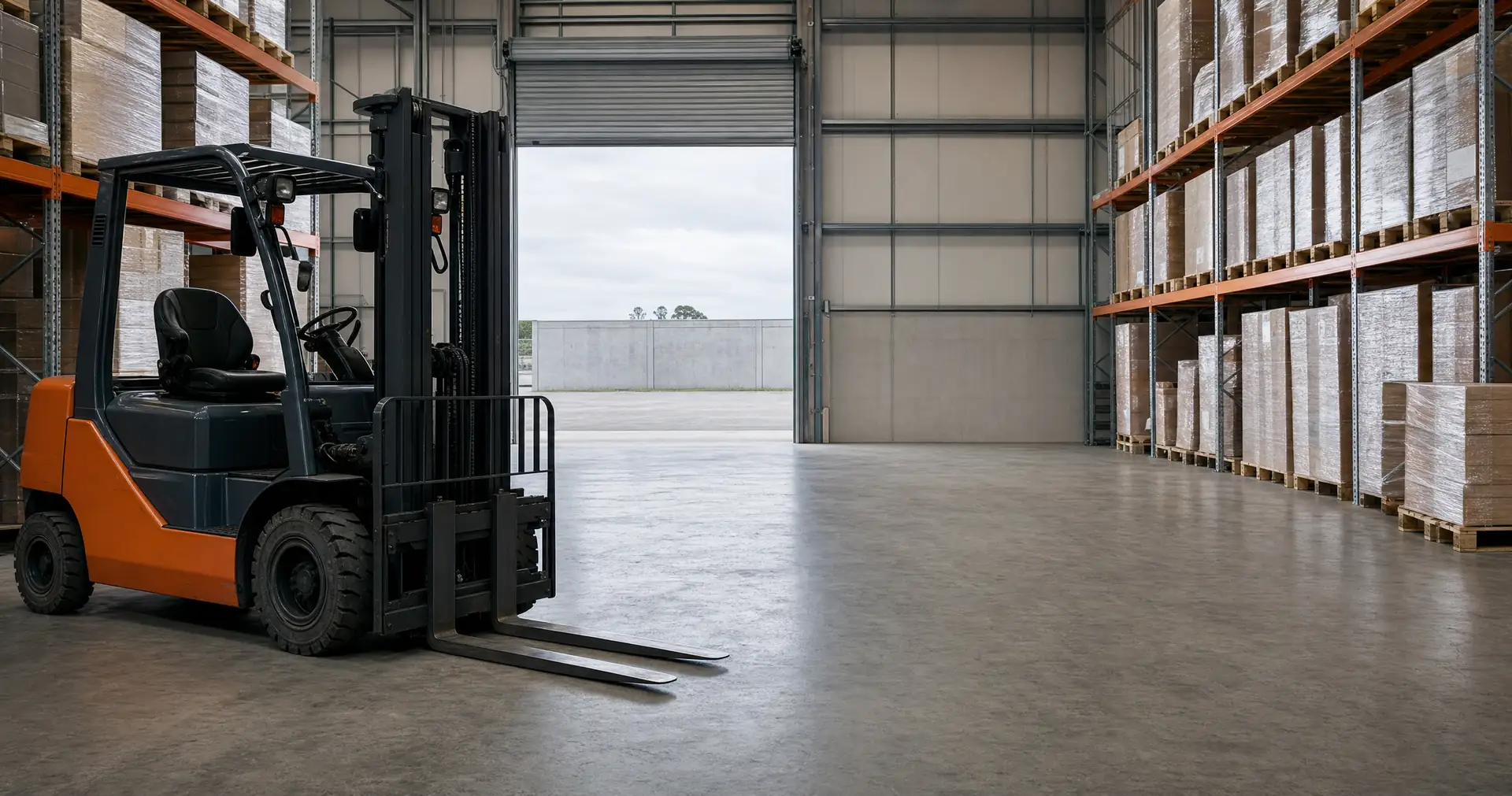
A forklift is among the most commonly financed pieces of plant in New Zealand, because it holds resale value, sits still in one yard, and is easy for a lender to identify and secure against.
Indicative only. Not a quote or offer of credit. Actual rates, fees, and repayments depend on the business profile and the lender's decision.
Sending to Prospa
Your $45,000 scenario
4 years at 11.00% . Prospa will ask a few quick questions, then provide a firm quote and funding if eligible.
Redirecting…
The short version
Forklift finance in five lines.
→The machine is the security. Because a forklift is identifiable, movable and resaleable, lenders will normally take it as the security rather than asking for a property charge. That is what separates this from unsecured business lending on price.
→Three structures dominate. Hire purchase ends in ownership, a finance lease spreads the cost against a residual, and an operating lease is closer to a long rental where the machine goes back. Each falls differently for GST and depreciation.
→Age caps matter on used machines. Lenders commonly limit the age the forklift will reach by the end of the term rather than its age on the day of purchase, which is what shortens available terms on older stock.
→A PPSR search is standard on private sales. A security interest registered against a used forklift follows the machine, not the seller, so the register is the first place a purchase gets checked.
→Indicative only. Every band on this page is illustrative. Actual rates, fees and terms come from the lender after assessment of the business and the specific machine.
What it is
Finance secured against a machine that stays put.
Forklift finance is a secured facility over a single identified machine. The lender registers a security interest on the Personal Property Securities Register, the business uses the forklift from day one, and the debt reduces on a fixed schedule. If the payments stop, the lender has a defined route to recover the machine, and that certainty is what allows the indicative pricing on asset finance to sit below unsecured lending for the same borrower.
A forklift is an unusually good asset from a lender’s point of view. It carries a serial number, it does not travel between regions the way a truck does, the New Zealand secondhand market for common counterbalance capacities is liquid, and hour meters give an objective read on remaining life. Machines outside that mainstream, such as container handlers, very high-capacity units, or specialised narrow-aisle equipment, are financed too, but the pool of lenders comfortable with them is smaller and terms are commonly shorter.
The amount financed is usually the machine plus the on-costs that make it usable. Attachments, mast changes, a battery and charger on an electric unit, and freight to site are all commonly rolled into the same agreement where they are part of the same purchase. Ongoing costs such as servicing and certification are not, and businesses commonly budget those separately rather than expecting them to sit inside the finance.
Common capacity band
1.8t to 3.0t
Indicative rate band
8% to 16% p.a.
Typical decision window
1 to 5 working days
Registered on
PPSR
Structures
Three ways a forklift is commonly financed.
The machine does not change. What changes is who owns it during the term, where it sits on the balance sheet, and when the GST falls. The differences are worth understanding before the paperwork is drawn, because switching structure afterwards means refinancing.
Hire purchase
The business takes possession immediately and title transfers at the end once the final payment is made. The forklift sits on the balance sheet as an asset from day one and the debt sits against it. This is the most common structure for New Zealand buyers who intend to keep the machine past the term.
·Ownership at the end of the term
·Depreciation typically claimed by the business, subject to the accountant’s confirmation
·Deposit commonly 0% to 20%
Finance lease
The financier holds title and the business leases the machine for the term, with a residual amount set at the start. Payments are typically lower than the equivalent hire purchase because the residual is not being repaid across the term, and the residual is settled, refinanced or the machine returned at the end.
·Lower payment for the same machine
·Residual decision at the end of the term
·Suits businesses replacing on a cycle
Operating lease
Closest to a long-term rental. The financier retains the machine and the risk of what it is worth at the end, and the business hands it back. Payments often bundle scheduled servicing. It suits operations that want a known monthly cost and no exposure to resale.
·Machine returns at the end of the term
·Servicing sometimes included
·No residual value exposure
Tax and GST
Where the GST falls depends on the structure, not the machine.
Under a hire purchase, a GST-registered business is generally able to claim the GST on the full purchase price in the return covering the period the agreement begins, rather than spreading it across the payments, subject to the accountant’s confirmation of the business’s accounting basis. Under an operating lease the GST is typically claimed on each rental as it is invoiced, again subject to the accountant’s confirmation. Depreciation follows ownership in the same way, so a hire purchase normally puts the depreciation claim with the business while an operating lease does not, again subject to the accountant’s confirmation on the specific arrangement. Inland Revenue publishes the applicable depreciation rates in its rate finder, and the category a particular forklift falls into is a question the accountant is the right person to settle.
By class
What each kind of forklift typically costs to buy.
Indicative New Zealand purchase bands, illustrative only. Condition, hours, attachments, mast height and whether the machine is new, near-new or an older import move these considerably, and a quoted price from a dealer is the only number that means anything for a specific purchase.
$12k to $40k used
LPG counterbalance
The default yard machine in New Zealand at 1.8 to 3.0 tonnes. Cheap to buy, quick to refuel, and the deepest used market of any class, which is why lenders are most comfortable here and terms run longest.
$25k to $75k
Electric counterbalance
Preferred where the work is indoors or noise and emissions matter. The battery is a meaningful share of the value and its age is assessed separately from the machine, because a tired battery can cost a significant fraction of the unit to replace.
$30k to $90k
Diesel counterbalance
Higher capacities and outdoor yard work, commonly 3 tonnes and above. Rough-terrain variants sit at the top of this band and are financed against a narrower lender pool because the resale market is thinner.
$35k to $110k
Reach truck
Narrow-aisle warehouse equipment that trades value for storage density. Financed readily, but tied to a particular racking layout, which lenders factor into how quickly a repossessed unit would resell.
$20k to $60k
Order picker
Operator lifts with the load. Common in distribution and third-party logistics. Usually financed as part of a fit-out package alongside racking rather than on its own.
$60k to $180k
Telehandler
Construction and rural work where reach matters more than lift capacity. Sits across the boundary between forklift and earthmoving finance, and is often quoted by lenders on their plant rather than their materials-handling terms.
$8k to $25k
Walkie stacker
Pedestrian-operated, for light work and tight spaces. Often below the minimum a specialist asset financier will write, so it commonly ends up on a general small-business facility instead.
$90k to $400k+
Container handler
Port and depot equipment. A small New Zealand market, a small pool of buyers if it has to be resold, and consequently the shortest terms and largest deposits of anything on this list.
The common case
A 2.5 tonne counterbalance in a leased warehouse.
The mainstream of the New Zealand market. Machines in this band have the deepest used market, which is what makes them the easiest forklifts to finance.
Indicative bands
How age and hours typically move the terms offered.
Indicative bands only, and not an offer of credit. Lenders assess the business first and the machine second, so a strong trading history commonly moves these more than the machine does.
Machine age at purchase
Typical maximum term
Deposit commonly sought
Notes
New
60 months
0% to 10%
Longest terms and the widest lender pool. Dealer finance is commonly available alongside independent financiers.
1 to 4 years
48 to 60 months
0% to 15%
The sweet spot for value. Hours matter more than years in this band.
5 to 8 years
36 to 48 months
10% to 20%
Terms are usually capped by the age the machine reaches at the end, not its age today.
9 to 12 years
24 to 36 months
20% or more
A smaller pool of lenders. Service history and a recent inspection carry more weight here than anywhere else.
Over 12 years
Case by case
Often 30%+
Frequently declined as asset finance and funded on an unsecured facility instead, at unsecured pricing.
Indicative New Zealand market bands for forklift finance by machine age. Illustrative, not an offer.
The alternatives
Finance, lease, rent or pay cash.
Businesses prioritising ownership and long-run cost typically finance. Businesses prioritising a flat monthly figure and no resale exposure typically lease or rent. The right answer depends on the business position rather than on the machine.
Feature
Hire purchase
Finance lease
Long-term rental
Cash purchase
Who owns it during the term
The business
The financier
The rental company
The business
Upfront cash required
Deposit only
Often nil
First month
Full price
Monthly cost
Higher
Lower, residual deferred
Highest, servicing bundled
None
Servicing
The business arranges
The business arranges
Commonly included
The business arranges
Exposure to resale value
Yes
At the residual
No
Yes
Fits when
The machine is wanted long term
Replacement runs on a cycle
Utilisation is uncertain
Cash has no better use
Cash looks cheapest in isolation and often is not, because the same money used as working capital may earn more than the finance costs. That comparison is specific to the business and is one the accountant is the right person to run.
The process
What a forklift finance application typically involves.
Written as an observation of what commonly happens rather than as instructions. Every lender differs, and none of this is a guarantee of an outcome.
01
Same day once a quote exists
The machine is identified first
Asset finance is written against a specific unit, so a quote or invoice naming the make, model, capacity, serial number, hours and price is normally what starts the file. Pre-approval without a machine is possible with some lenders but is commonly re-priced once the actual unit is known.
Documents commonly required
·Dealer quote or invoice
·Serial number and hour reading
02
1 to 3 working days
The business is assessed
Trading history carries more weight than the machine. Twelve months of bank statements is the common request, alongside the NZBN and GST registration details. Businesses trading under a year are not excluded but are typically asked for a deposit or a guarantee.
Documents commonly required
·12 months of bank statements
·NZBN
·GST and IRD details
·Financial statements above larger amounts
03
Same day
The security position is checked
A PPSR search on the machine is standard, and on a private sale it is the step that matters most. A registered security interest travels with the forklift rather than with the seller, so a machine sold with finance still owing against it can be recovered from a buyer who paid in full.
Documents commonly required
·PPSR search result
·Evidence of the seller’s title on private sales
04
1 to 2 working days after acceptance
Documents are issued and settlement occurs
Once terms are accepted, the financier commonly pays the seller directly rather than paying the business, and registers its own security interest on the PPSR. Delivery is arranged between the buyer and the seller, and the first payment usually falls a month after settlement.
Documents commonly required
·Signed finance agreement
·Insurance certificate naming the financier
Insurance is normally a condition rather than an option. Financiers commonly require the machine insured for its full value with their interest noted, and settlement is often held until the certificate arrives.
Worked scenarios
Three New Zealand forklift purchases, illustratively.
Illustrative scenarios on stated assumptions. The figures are indicative and are produced by the calculator on this page rather than quoted by any lender.
Six years trading, two existing machines, replacing the oldest
A South Auckland third-party logistics operator
The operator runs a leased warehouse in Wiri and needs a third 2.5 tonne LPG counterbalance to cover a seasonal contract that runs from March. A four-year-old machine is quoted at $32,000 plus GST by a dealer, with 4,100 hours on it.
On these assumptions, a 48-month hire purchase at an indicative 11% carries a repayment in the region of $190 a week. The business is GST registered on a two-monthly basis, so the GST on the purchase price is generally claimable in the return covering the period the agreement starts, subject to the accountant’s confirmation. In this scenario the contract revenue comfortably covers the payment, which is the comparison that actually decides it.
Indicative figures
Machine price
$32,000 + GST
Term
48 months
Indicative rate
11% p.a.
Indicative weekly
~$190
Moving from LPG to electric for an indoor production area
A Canterbury food manufacturer
The business is bringing pallet movement inside a chilled production area where combustion machines are unsuitable, and is quoted $58,000 plus GST for a new electric counterbalance with a charger.
A finance lease is chosen over a hire purchase because the plan is to replace the machine on a five-year cycle rather than run it to the end of its life. On these assumptions a 60-month lease with a residual set at the start carries a lower payment than the equivalent hire purchase, and the residual decision is deferred to the end of the term. The battery age is assessed separately in the valuation, which is specific to electric machines and does not arise on the LPG unit it replaces.
Indicative figures
Machine price
$58,000 + GST
Structure
Finance lease
Term
60 months
Residual
Set at inception
Two years trading, strongly seasonal revenue
A Hawke’s Bay packhouse
The packhouse needs two machines for a season that runs roughly February to May and sits close to idle for the rest of the year. Buying outright would tie up capital in equipment used for four months.
In this scenario an operating lease on one machine and short-term rental on the second is the structure that fits the utilisation pattern, because it moves the resale risk to the lessor and matches cost to the months the machines actually work. The trade is that nothing is owned at the end, which is the cost of not carrying the risk.
Indicative figures
Machines
2
Season length
~4 months
Structure
Operating lease plus rental
Owned at end
Nothing
If it goes wrong
What happens when payments stop.
Asset finance is secured, and the consequence of default is different from an unsecured loan. Set out here as fact rather than as a warning, because it is part of what the structure is.
The security interest is enforced
The financier registered its interest on the PPSR at settlement. On default it has a defined statutory route to take possession of the machine under the Personal Property Securities Act 1999, which is why the pricing sits below unsecured lending in the first place.
What happens:The forklift is recovered and the business loses use of it.
A shortfall can remain after sale
The machine is sold and the proceeds are applied to the debt. Where the sale raises less than the balance owing, the difference commonly remains payable by the business, and by any guarantor who signed. Depreciation on plant is front-loaded, so a shortfall is more likely early in a term than late in one.
What happens:A residual debt survives the loss of the asset.
A personal guarantee reaches beyond the company
Where a director has guaranteed the facility, which is common on smaller New Zealand asset finance, the guarantee is a separate obligation that survives the company’s position. The Credit Contracts and Consumer Finance Act can also apply where a sole trader’s borrowing is wholly or predominantly for personal use, which is a narrower case but not an impossible one.
What happens:Recovery can extend to the guarantor personally.
Where trading conditions change, lenders are commonly willing to discuss restructuring before arrears build, and a conversation held early has more options available to it than one held late.
Honest assessment
Where forklift finance fits, and where it does not.
Where it fits
·The machine is needed for years rather than months, and utilisation is predictable
·The business would rather keep its cash working than convert it into plant
·The forklift is a mainstream capacity with a deep New Zealand used market
·The purchase has a clear revenue justification, such as a contract that requires it
·The business is GST registered and trading, so the tax treatment is straightforward
Where it does not
·Utilisation is genuinely seasonal, where rental commonly costs less over a year
·The machine is very old or very specialised, where terms shorten and pricing rises sharply
·The business is under three months old, where asset finance is rarely available without security elsewhere
·The amount is small enough that establishment fees outweigh the rate advantage
·Existing arrears exist on other facilities, which typically has to be resolved first
The market
Who writes forklift finance in New Zealand.
Editorial only. These are the kinds of lender active in New Zealand materials-handling finance, listed to describe the market rather than to recommend any of them. We hold no relationship with the lenders named here and receive nothing if a reader approaches them.
Best for established borrowers
Bank asset finance divisions
The major New Zealand banks all write plant and equipment finance, typically at the sharpest indicative pricing and the slowest pace. Most useful where the business already banks with them and has financial statements available.
Best for machine-led decisions
Specialist asset financiers
Non-bank financiers whose credit teams assess the machine as closely as the borrower. Commonly more flexible on older units and unusual classes than a bank, at an indicative rate band above bank pricing.
Best for new machine purchases
Dealer finance programmes
Forklift dealers frequently have a finance arrangement attached to new stock. Convenient and sometimes subsidised on particular models, and worth comparing against an independent quote rather than accepted on convenience.
Best for uncertain utilisation
Equipment rental companies
Not lenders, but a genuine alternative for seasonal or short-horizon needs. Long-term rental bundles servicing and removes resale exposure, at a higher monthly cost than owning.
Names are deliberately generic. A comparison of specific lenders would need current pricing we cannot substantiate, and publishing it would be a claim rather than information.
Test the maths
A forklift purchase, in weekly numbers.
Pre-filled with a mainstream counterbalance purchase over four years. Moving the sliders shows how term and rate change the weekly figure. Indicative only, and not a quote or offer of credit.
Backs the note that the CCCFA can reach a sole trader whose borrowing is wholly or predominantly for personal use.
FAQ
Forklift finance in New Zealand, questions answered
What is forklift finance in New Zealand?
Forklift finance is a secured facility taken over a specific machine, where the forklift itself carries the security rather than a property charge. The lender registers its interest on the Personal Property Securities Register and the business has use of the machine from settlement. Because the security is identifiable and resaleable, indicative pricing generally sits below unsecured business lending for the same borrower.
How much does a forklift typically cost to finance in New Zealand?
Most New Zealand yards finance between $18,000 and $95,000, which covers the mainstream 1.8 to 3.0 tonne counterbalance market new and used. Specialised equipment such as container handlers or high-capacity diesel machines runs well above that. The figures on this page are indicative bands rather than quotes, and a dealer price for a specific machine is the only number that decides an actual purchase.
How long can a forklift be financed for?
Terms of 24 to 60 months are the common range. The limit is usually driven by the age the machine reaches at the end of the term rather than its age at purchase, which is why an eight-year-old forklift often attracts a shorter term than a two-year-old one at the same price. Longer terms lower the payment and raise the total interest paid.
Is a deposit required on forklift finance?
Not always. Nil-deposit facilities are commonly available on newer machines for businesses with a reasonable trading history. Deposits are more often sought where the machine is older, the class is specialised, or the business has been trading under two years. A deposit reduces the lender’s exposure and typically improves the indicative rate offered.
What is the difference between a hire purchase and a finance lease on a forklift?
Under a hire purchase the business takes the machine onto its balance sheet from day one and title transfers at the end of the term. Under a finance lease the financier holds title, a residual is set at inception, and payments are usually lower because the residual is not repaid across the term. Businesses prioritising ownership commonly choose hire purchase; businesses replacing on a fixed cycle often prefer the lease.
When is the GST claimable on a financed forklift?
Under a hire purchase, a GST-registered business is generally able to claim the GST on the full purchase price in the return covering the period the agreement begins rather than spreading it across the payments, subject to the accountant’s confirmation of the accounting basis used. Under an operating lease the GST is typically claimed on each rental as it is invoiced, again subject to the accountant’s confirmation. The distinction follows the structure rather than the machine.
Can depreciation be claimed on a financed forklift?
Where the business is treated as the owner, which is the usual position under a hire purchase, depreciation is generally claimed by the business at the rate Inland Revenue publishes for the applicable asset category, subject to the accountant’s confirmation. Under an operating lease the financier ordinarily retains ownership and the depreciation claim with it, and the business claims the rental as an expense instead.
Why does a PPSR search matter when buying a used forklift?
A security interest registered on the Personal Property Securities Register attaches to the machine, not to the person selling it. A forklift sold privately with finance still owing can therefore be recovered from a buyer who paid the full price in good faith. A search on the serial number is inexpensive and is standard practice on any private plant purchase in New Zealand.
Can a new business get forklift finance?
It is harder but not impossible. Businesses trading under twelve months are commonly asked for a deposit, a personal guarantee, or both, and the pool of lenders willing to write the facility narrows. Where the business is under three months old, asset finance is rarely available on the machine alone and the funding usually has to come from elsewhere.
What happens if the business cannot keep up the payments?
The financier can enforce its registered security interest under the Personal Property Securities Act 1999 and take possession of the machine. The forklift is then sold and the proceeds applied to the debt. Where the sale raises less than the balance owing, the shortfall commonly remains payable by the business and by any guarantor. Lenders are frequently open to restructuring where the position is raised before arrears accumulate.
Is renting a forklift cheaper than financing one?
It depends almost entirely on utilisation. Over full-time year-round use, financing is typically the lower total cost because the payments end and an asset remains. Over a four-month season, rental commonly costs less across a year and carries no resale exposure. The comparison turns on how many months the machine actually works rather than on the headline monthly figures.
Does forklift finance cover attachments and delivery?
Usually, where they form part of the same purchase. Attachments, a mast change, a battery and charger on an electric machine, and freight to site are commonly financed inside the same agreement. Ongoing costs such as servicing, certification and operator training sit outside it, and businesses commonly budget for those separately.
Is insurance required on a financed forklift?
Normally yes. Financiers commonly require the machine insured for its full value with their interest noted on the policy, and settlement is often held until the certificate is provided. This is a condition of the facility rather than an optional extra, and lapsing the cover during the term is typically a breach of the agreement.
Indicative content only. Not personalised financial advice.
Financing a machine is a commitment that runs for years, and the repayments come out of the same operating cash flow as everything else. Modelling the weekly and monthly cost against the working-capital position before committing is what this site is built for. Borrowing at a level that stays comfortable through a quiet quarter, rather than only through a strong one, is widely regarded as the safer frame.
What this site is
A calculator and information tool. Not a lender, not a broker, not a registered financial adviser. Nothing here is personalised financial advice.
What the figures show
Modelled estimates based on the inputs shown. Not a quote. Not an offer of credit. Not a guarantee of approval, rate or fees.
What the lender decides
Final rates, fees, and approval are set by the lender after a CCCFA-appropriate assessment of the applicant's circumstances and credit decision.
Commercial disclosure
Equipmentfinance.org.nz earns a commission from Prospa when a visitor applies through this site and their application is approved. The commission is paid by Prospa, not by the borrower, and it does not influence the rate Prospa offers. Full disclosure on the partner page.
Tax, GST, and accountant framing
Tax-treatment statements (GST claim timing, interest deductibility, depreciation rates) are general in nature and subject to the accountant's confirmation on the specific business position. For material amounts, professional advice from a registered financial adviser or chartered accountant is widely regarded as the safer frame.