
Compact, 25 to 50 hp
Lifestyle blocks, orchards and yard work. Small amounts that sometimes fall below the minimum a specialist rural financier will write, in which case a general business facility takes it instead.
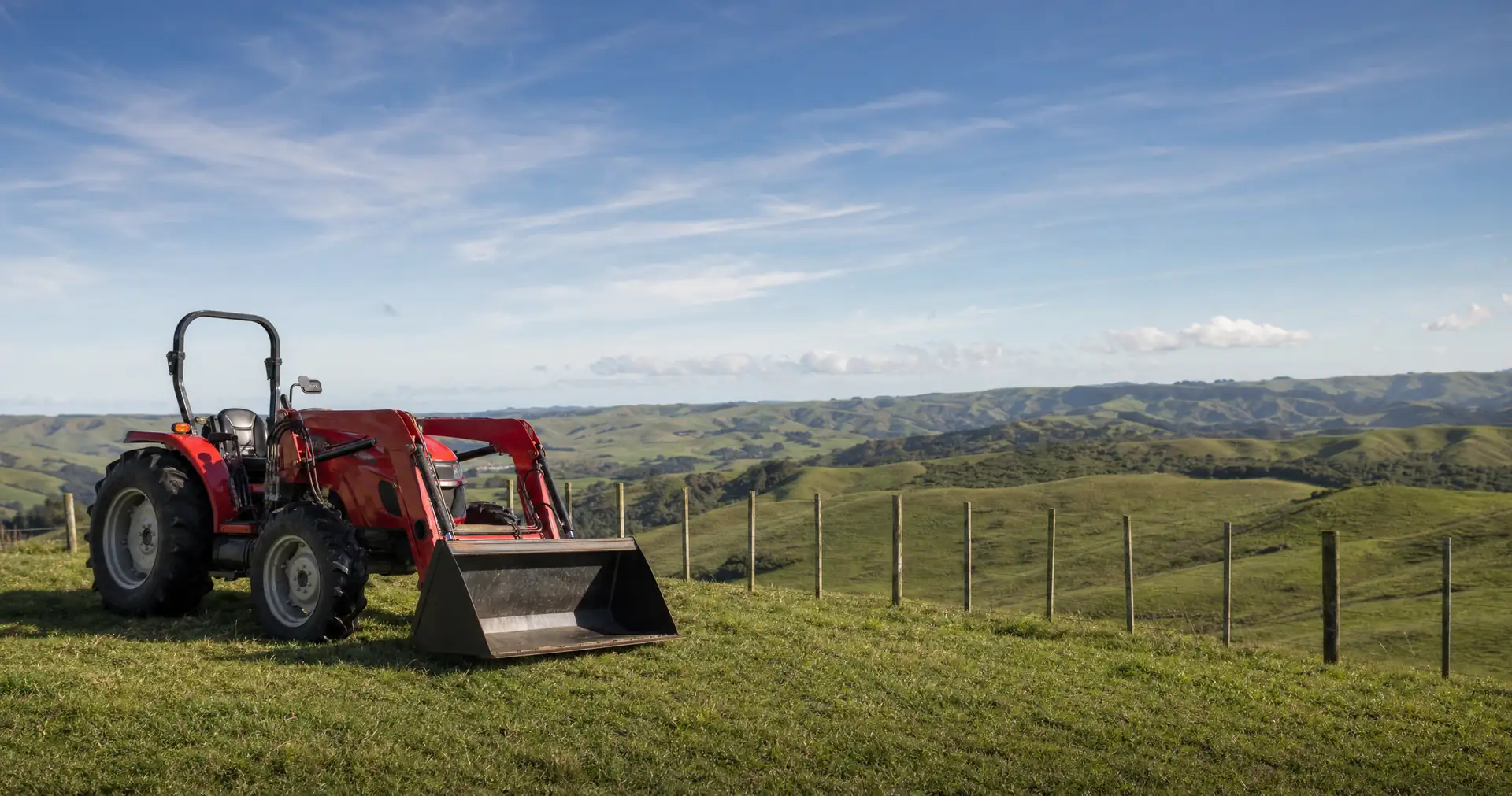
A tractor holds its value better than most plant and works for decades, which is why lenders will run longer terms on it than on almost anything else a rural business finances.
Last reviewed 7 September 2026
Indicative repayment
Weekly
$703/week
Indicative only. Not a quote or offer of credit. Actual rates, fees, and repayments depend on the business profile and the lender's decision.
Sending to Prospa
5 years at 9.50% . Prospa will ask a few quick questions, then provide a firm quote and funding if eligible.
Redirecting…
The short version
What it is
Tractor finance is a secured facility over an identified machine, with the lender registering a security interest on the Personal Property Securities Register. The structure is the same one used for any equipment purchase. What differs is the borrower, because a rural business has a cash-flow pattern that a suburban workshop does not, and the schedule has to fit it.
Lenders like tractors for a reason that is easy to overlook. A well-maintained machine works for fifteen years or more, the New Zealand demand base spans dairy, sheep and beef, horticulture, viticulture, cropping and contracting, and second-hand values hold up in a way that earthmoving plant of a comparable price does not. That depth supports longer terms, smaller deposits and indicative pricing at the lower end of the equipment range.
What gets financed is the machine and what it pulls or carries. A front-end loader, a mower conditioner, a baler, a spreader or a set of forks bought at the same time are commonly listed on the same schedule. Consumables, tyres replaced during the term and servicing are not, and farms commonly budget those against the operating account rather than against the finance.
Common power band
90 to 150 hp
Indicative rate band
7% to 14% p.a.
Typical working life
15 years or more
Registered on
PPSR
By power class
Indicative New Zealand purchase bands, illustrative only. Hours, condition, transmission type, cab specification, loader and whether the machine is new or used all move these considerably. A dealer quote decides an actual purchase.
Lifestyle blocks, orchards and yard work. Small amounts that sometimes fall below the minimum a specialist rural financier will write, in which case a general business facility takes it instead.
The default machine on smaller dairy and sheep and beef units. Deep used market, long terms available, and the class where a loader is almost always part of the package.
Larger dairy platforms and contract work. Machines here are commonly bought new and traded on a cycle rather than run to the end of their life.
Cropping and agricultural contracting. Large individual amounts and a narrower New Zealand buyer pool, so deposits are more often sought.
Narrow specification for row work in horticulture and viticulture. A specialised resale market that is regionally concentrated, which lenders factor into how quickly a machine would sell.
Frequently fitted at purchase and financed on the same schedule. Retro-fitting to an existing machine is financed separately and on shorter terms.
Seasonal implements with a short intense working window. Commonly financed alongside a tractor because the two are bought as one capability.
Compliance-relevant equipment where certification and calibration sit outside the finance. Values hold reasonably well where service records exist.
The common case
The seasonal question
A repayment schedule that takes the same amount every week assumes income arrives the same way. On a dairy platform it does not, because payout timing concentrates receipts. On a cropping farm it does not, because a harvest is a single event. On a packhouse it does not, because the season is a few months long. The mismatch is not a problem for a business holding a working-capital buffer, and it is a real one for a business that is not.
Some New Zealand lenders will structure a rural facility to follow that pattern, with higher payments through the months income arrives and reduced or interest-only periods through the months it does not. Others will not, and will simply set an even schedule. The availability varies enough that it is worth asking at the quote stage rather than after the documents are drawn, because changing the shape afterwards means refinancing.
The trade is straightforward and worth understanding. A schedule with lighter off-season payments carries more interest across the term, because the principal reduces more slowly through part of each year. What the business is buying with that extra cost is room in the months when there is none, and whether that is worth paying for is specific to the farm rather than a general answer.
Tax and GST
Under a hire purchase, a GST-registered farming business is generally able to claim the GST on the full purchase price in the return covering the period the agreement begins rather than spreading it across the payments, subject to the accountant’s confirmation of the accounting basis used. Under an operating lease the GST is typically claimed on each rental as it is invoiced, again subject to the accountant’s confirmation. Depreciation follows ownership in the same way. Inland Revenue publishes the applicable rates for agricultural plant in its depreciation rate finder, and which category a particular machine falls into, along with any interaction with other farm-specific provisions, is a question the accountant is the right person to settle.
Indicative bands
Indicative bands only, and not an offer of credit. Lenders assess the farming business first and the machine second, and a long trading history commonly moves these more than the tractor does.
| Machine condition | Typical maximum term | Deposit commonly sought | Notes |
|---|---|---|---|
| New | 60 months | 0% to 10% | Longest terms and the widest lender pool. Dealer programmes are strong in this class and commonly competitive. |
| Under 2,500 hours | 48 to 60 months | 0% to 10% | Treated close to new. Service records and a known dealer history carry real weight here. |
| 2,500 to 6,000 hours | 36 to 60 months | 10% to 20% | A normal purchase rather than a marginal one. Tractors at this reading commonly have most of their working life ahead of them. |
| 6,000 to 10,000 hours | 24 to 48 months | 15% to 25% | Still financed readily where maintenance is documented. Transmission and hydraulic condition matter more than the hour meter. |
| Over 10,000 hours | Case by case | Often 25%+ | A smaller pool of lenders, and terms set against remaining life rather than against price. |
Indicative New Zealand market bands for tractor finance by machine condition. Illustrative, not an offer.
The alternatives
Farms prioritising control and long-run cost typically finance. Farms prioritising a known annual cost with no machinery risk typically contract the work out. The right answer follows the operation rather than the machine.
| Feature | Hire purchase | Finance lease | Contract the work | Buy used outright |
|---|---|---|---|---|
| Who owns it | The farm | The financier | The contractor | The farm |
| Upfront cash | Deposit only | Often nil | None | Full price |
| Cost when idle | Full payment | Full payment | None | Depreciation only |
| Labour required | The farm supplies it | The farm supplies it | Included | The farm supplies it |
| Timing control | Full | Full | Shared with the contractor | Full |
| Fits when | The work is year-round | Replacement runs on a cycle | The task is a few weeks a year | Cash has no better use on farm |
Contracting out looks expensive per hour and frequently is not, because it carries no idle cost, no depreciation and no labour. Where the task is a few weeks a year, that comparison commonly favours the contractor, and it is specific to the farm.
The process
Written as an observation of what commonly happens rather than as instructions. Every lender differs, and none of this is a guarantee of an outcome.
01
Same day once a quote exists
A quote naming the make, model, year, serial number, hour reading and any loader or implements is normally what opens the file. Implements bought at the same time usually sit on the same schedule rather than becoming a second facility.
Documents commonly required
02
3 to 10 working days
Trading history carries more weight than the machine. Financial statements are requested more often in rural lending than in general equipment finance, because the seasonality makes a bank statement alone a poor picture. Lenders commonly ask about the sector and the payout or contract position behind the income.
Documents commonly required
03
Within the assessment window
Where a seasonal structure is available, this is the point it is set. The pattern is matched to when income actually arrives for that sector, and it forms part of the offer rather than something adjustable later. A PPSR search runs at the same time on any used purchase.
Documents commonly required
04
2 to 5 working days after acceptance
The financier commonly pays the dealer directly and registers its security interest on the PPSR. Delivery is arranged between the farm and the dealer, and the first payment usually falls a month after settlement unless a seasonal structure moves it.
Documents commonly required
Insurance covering the machine on farm and in transit is normally a condition rather than an option, and settlement is often held until the certificate arrives.
Worked scenarios
Illustrative scenarios on stated assumptions. The figures are indicative and are produced by the calculator on this page rather than quoted by any lender.
260 hectares, replacing an ageing utility tractor
The existing machine is at 11,000 hours and the repair bill has become unpredictable ahead of calving. A new 110 horsepower tractor with a front-end loader is quoted at $178,000 plus GST.
On these assumptions a 60-month hire purchase at an indicative 9.5% carries a repayment in the region of $860 a week on an even schedule. A seasonal structure that lightens the winter months raises the total interest and lowers the pressure in the months when the payout has not yet landed, which in this scenario is the trade the business chooses to make.
Indicative figures
Narrow-row work across 40 hectares
The vineyard needs a second narrow tractor to cover spraying and mowing through a compressed spring window. A three-year-old machine with 1,900 hours is quoted at $78,000 plus GST.
The resale market for narrow orchard and vineyard specification is smaller and regionally concentrated, which in this scenario shortens the term offered rather than raising the rate. On a 48-month term at an indicative 10% the weekly figure lands near $400. The compressed season is the reason a second machine exists at all, and the finance decision follows that rather than the hours.
Indicative figures
Contract harvesting across several farms
The contractor is adding a 220 horsepower machine to service a growing book, quoted at $340,000 plus GST, and is trading a machine with finance still owing on it.
In this scenario the trade value clears the outstanding balance with a surplus, and the surplus becomes the deposit. That reduces the amount financed and typically improves the indicative rate offered. The point worth checking before signing is whether the trade actually clears the balance, because depreciation is front-loaded and a shortfall carried into a new agreement raises the cost of the replacement rather than the machine being replaced.
Indicative figures
If it goes wrong
Asset finance is secured, and rural lending carries one statutory feature general equipment finance does not. Set out here as fact rather than as a warning.
The financier registered its interest on the PPSR at settlement and has a defined statutory route to take possession under the Personal Property Securities Act 1999. The machine is then sold and the proceeds applied to the debt.
What happens:The tractor is recovered and the farm loses the capability it carried.
The Farm Debt Mediation Act 2019 requires a creditor to offer mediation before taking enforcement action on farm debt owed by a farming business, subject to the Act’s own definitions and thresholds. Whether a particular equipment facility falls inside that scheme is a legal question specific to the debt and the borrower.
What happens:A mediation step can precede enforcement on qualifying farm debt.
Where the sale raises less than the balance owing, the difference commonly remains payable by the business and by any guarantor. Tractors hold value better than most plant, which narrows this gap relative to other equipment, without closing it.
What happens:A residual debt can survive the loss of the machine.
Where a season disappoints, lenders familiar with rural cash flow are commonly willing to discuss restructuring before arrears build, and a conversation held early has more options available to it than one held late.
Honest assessment
The market
Editorial only. These are the kinds of lender active in New Zealand rural equipment finance, listed to describe the market rather than to recommend any of them. We hold no relationship with the lenders named here and receive nothing if a reader approaches them.
Best for established farming businesses
The major banks run dedicated rural teams that understand seasonal cash flow and commonly offer the sharpest indicative pricing. Usually the first place a farm with an existing banking relationship looks.
Best for seasonal structures
Non-bank financiers focused on agricultural plant, often more willing to shape a schedule around a season than a general equipment lender would be, at an indicative rate above bank pricing.
Best for new machine purchases
Tractor dealers frequently run finance attached to new stock, sometimes subsidised on particular models or at particular times of year. Worth comparing against an independent quote.
Best for short seasonal tasks
Not lenders, but the honest alternative where a machine would work a few weeks a year. Contracting carries no idle cost, no depreciation and no labour requirement.
Names are deliberately generic. A comparison of specific lenders would need current pricing we cannot substantiate, and publishing it would be a claim rather than information.
Test the maths
Pre-filled with a mid-range machine and loader over five years, on an even schedule. Indicative only, and not a quote or offer of credit.
Indicative repayment
Weekly
$703/week
Indicative only. Not a quote or offer of credit. Actual rates, fees, and repayments depend on the business profile and the lender's decision.
Sending to Prospa
5 years at 9.50% . Prospa will ask a few quick questions, then provide a firm quote and funding if eligible.
Redirecting…
References
Backs the statements about security interests registered against a machine.
The statutory basis for the mediation step described in the default section.
The published source for the depreciation treatment referred to on this page.
Backs the description of when GST is generally claimable under each structure.
Context for the sector descriptions and the seasonality of New Zealand farm income.
Context for the description of New Zealand rural sectors and their equipment mix.
FAQ
Tractor finance is a secured facility taken over a specific machine, with the tractor itself carrying the security rather than a property charge. The lender registers its interest on the Personal Property Securities Register and the farm has use of the machine from settlement. Because tractors hold value well and the New Zealand demand base is broad, indicative pricing generally sits at the lower end of the equipment finance range.
Some New Zealand lenders will set a schedule that follows farm income rather than spreading evenly across the year, with heavier payments through the months receipts arrive and lighter or interest-only periods through the months they do not. Availability varies considerably between lenders, so it is worth raising at the quote stage rather than after documents are drawn.
Most rural businesses finance between $45,000 and $320,000, which spans utility machines through to high horsepower cropping tractors. Compact machines sit below that and specialist contracting units above it. The figures on this page are indicative bands rather than quotes, and a dealer price decides an actual purchase.
Terms of 36 to 60 months cover most New Zealand tractor finance, and 60 is available more readily here than on other plant because working lives are long and resale values hold. The ceiling is usually driven by the condition and hours the machine reaches at the end of the term.
Commonly yes, where they form part of the same purchase. A front-end loader, mower conditioner, baler, spreader or set of forks bought at the same time is usually listed on the same schedule and funded as one facility. Retro-fitting to an existing machine is normally a separate and shorter facility.
Less than on earthmoving plant, though they still matter. A well-maintained tractor at 6,000 hours commonly has most of its working life ahead of it, and transmission and hydraulic condition together with documented servicing carry more weight with a lender than the meter reading alone.
Not always. Nil-deposit facilities are commonly available on newer machines for farming businesses with an established trading history. Deposits are more often sought on high-hour machines, on narrow orchard and vineyard specifications with a thinner resale market, and on newer businesses. A trade-in frequently serves as the deposit.
Under a hire purchase, a GST-registered farming business is generally able to claim the GST on the full purchase price in the return covering the period the agreement begins rather than across the payments, subject to the accountant’s confirmation of the accounting basis used. Under an operating lease the GST is typically claimed on each rental as it is invoiced, again subject to the accountant’s confirmation.
The Farm Debt Mediation Act 2019 requires creditors to offer mediation before enforcement on farm debt owed by a farming business, subject to the definitions and thresholds in the Act itself. Whether a particular equipment facility falls inside the scheme is a legal question specific to that debt and that borrower, and it is one a solicitor is the right person to answer.
For a task that runs a few weeks a year, commonly yes. A contractor carries the machine cost, the depreciation, the idle time and the labour, and charges only for the work done. For year-round work the comparison reverses, because a contractor is charging for all of those on every hour while an owned machine spreads them across the whole year.
The outstanding balance is normally settled from the trade value, and any surplus becomes the deposit on the replacement. Where the trade does not clear the balance, the shortfall is either paid or, with some lenders, rolled into the new agreement, which raises the cost of the replacement rather than of the machine being replaced.
A trading farming business with a reasonable history is the straightforward case. A lifestyle block without business income is commonly assessed on the owner’s personal position instead, which changes the product and can bring the Credit Contracts and Consumer Finance Act into scope where the borrowing is wholly or predominantly for personal use.
Related
Excavator and digger finance
The same structures applied to earthmoving plant, where hours matter more.
Read onTrailer finance
Moving machines and stock between blocks, and how that is funded.
Read onAgriculture equipment finance
How New Zealand farms and packhouses approach equipment as a sector.
Read onWhat equipment lenders assess
Why rural applications more often need financial statements.
Read onEnd of term and upgrade options
Trading in with debt outstanding, and how replacement cycles are funded.
Read onAll equipment finance guides
Every machine class covered on this site.
Read onDisclaimer
Financing a machine is a commitment that runs for years, and the repayments come out of the same operating cash flow as everything else. Modelling the weekly and monthly cost against the working-capital position before committing is what this site is built for. Borrowing at a level that stays comfortable through a quiet quarter, rather than only through a strong one, is widely regarded as the safer frame.
What this site is
A calculator and information tool. Not a lender, not a broker, not a registered financial adviser. Nothing here is personalised financial advice.
What the figures show
Modelled estimates based on the inputs shown. Not a quote. Not an offer of credit. Not a guarantee of approval, rate or fees.
What the lender decides
Final rates, fees, and approval are set by the lender after a CCCFA-appropriate assessment of the applicant's circumstances and credit decision.
Commercial disclosure
Equipmentfinance.org.nz earns a commission from Prospa when a visitor applies through this site and their application is approved. The commission is paid by Prospa, not by the borrower, and it does not influence the rate Prospa offers. Full disclosure on the partner page.
Tax, GST, and accountant framing
Tax-treatment statements (GST claim timing, interest deductibility, depreciation rates) are general in nature and subject to the accountant's confirmation on the specific business position. For material amounts, professional advice from a registered financial adviser or chartered accountant is widely regarded as the safer frame.